
Socialhyp
November 20, 2026
AI vs Traditional Mobile App Development: Key Differences
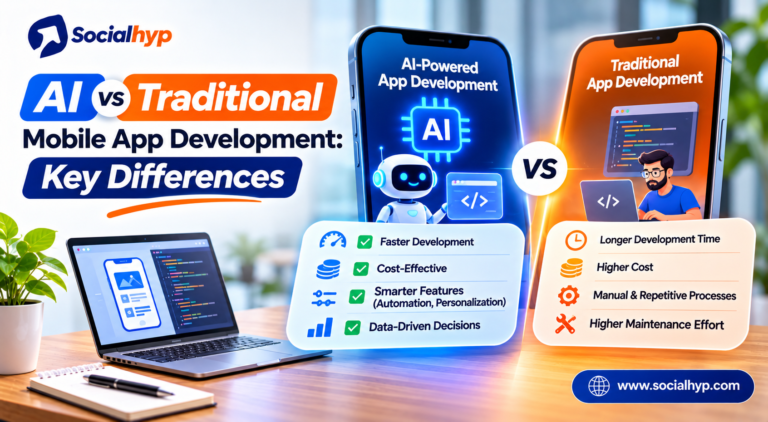
Apps are changing fast. AI in mobile app development lets an app learn from users and act on its own. Traditional development builds apps with fixed rules that never change on their own. Both ways work, but they fit different goals. In this guide, Social Hyp explains the key differences in plain words. You will learn how each method works, what it costs, and which one suits your business.
What Is Traditional Mobile App Development?
Traditional development follows a fixed plan. Developers write code for every feature. Each screen, button, and action follows rules the team set by hand. When a user taps a button, the app does exactly what the code says.
This method has worked for years. It is steady and easy to predict. Calculators, booking tools, and simple stores still use it. The cost is lower at the start, and the team knows what the app will do.
The limits are clear, though. The app cannot learn. It treats every user the same way. If you want a change, a developer must update the code.
What Is AI in Mobile App Development?
AI in mobile app development means adding smart tools that let an app learn from data. The app does not only follow fixed rules. It studies user actions and learns what people like. Over time, it gets better.
Picture a shopping app that shows shoes you really want. Or a fitness app that changes your plan each week. These are AI mobile apps at work. The app watches, learns, and responds.
Many artificial intelligence apps can also read text, hear voice, and scan photos. They answer a question or spot a pattern in seconds.
Key Differences Between AI and Traditional Mobile App Development
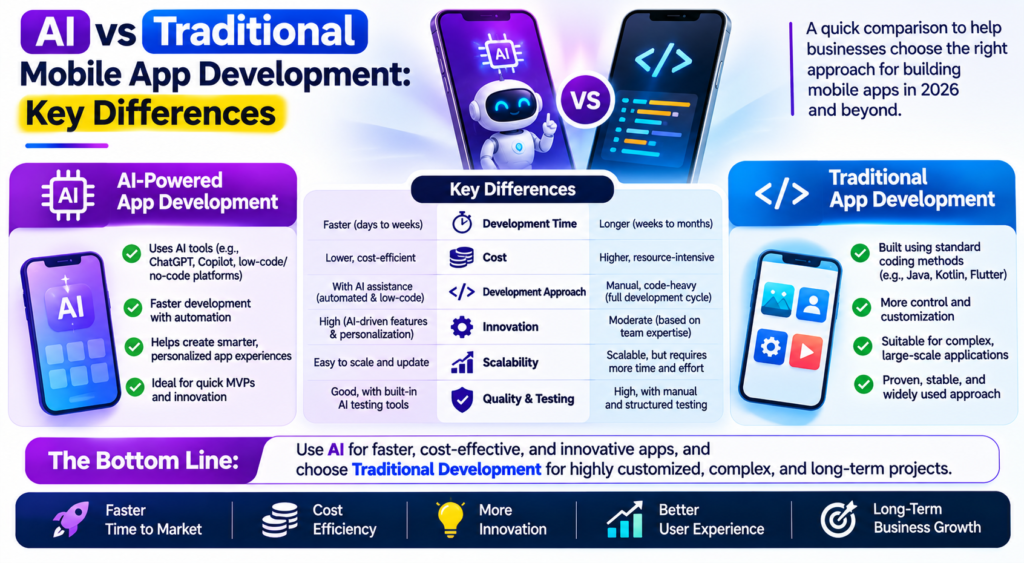
Both methods build working apps. The gap lies in how the app thinks, grows, and serves users. Here are the main points.
Learning Skill
Traditional apps stay the same until a developer changes them. AI apps learn from each tap, search, and purchase. Machine learning apps get better as they collect more data. A traditional app on day 500 works just like it did on day one.
Personal Touch
A traditional app shows the same home screen to everyone. Most AI mobile apps build a screen for each person. They pick content, offers, and order based on past habits. Users feel the app knows them. This keeps people in the app longer and lifts sales.
Common AI app features include smart search, voice commands, face login, and photo scanning.
Decision Making
Traditional apps show reports after something happens. With predictive analytics, an app can guess what comes next. A food app can tell when you may order lunch. A store app can spot items that will sell out soon. Owners can plan stock and offers early.
Customer Support
Traditional apps rely on contact forms and email. Support staff reply only during work hours. Chatbot integration changes that. A chatbot answers questions at any hour. It fixes simple issues at once and hands hard ones to a person. Wait time drops, and so does cost.
Task Handling
Traditional apps need people for many jobs. Someone must sort data, send reminders, or approve forms. App automation does these jobs on its own. It sends reminders at the right time, sorts requests, and flags problems. Your team can focus on work that needs a human.
Cost and Time
Traditional development costs less at first and takes less time. The process employs already known instruments and steps. AI in the mobile application development process will cost you more from the start. Data, training, and testing are required. However, automation and sales growth of the app will return the money in the long run.
Data and Privacy
AI applications require data to function properly. In other words, you will have to protect user data carefully. Seek consent from users, encrypt data, and comply with all the laws. Traditional applications require collecting less data, so the risks are reduced.
Upkeep
Traditional apps need manual updates. AI apps keep learning, but developers must still check the models for errors. Test results often and retrain models when data changes.
Real Examples You Already Use
You meet AI every day. Google Maps uses predictive analytics to guess your travel time from live traffic. Banks use machine learning apps to flag odd card activity before money is lost. Music apps suggest songs you may like. Many artificial intelligence apps in health track your sleep and steps, then give tips. Online stores add chatbot integration to answer order questions at night.
Benefits and Limits of Each Approach
Traditional apps, less cost, ease of testing, less worry about data. Downsides are no learning, one view per person, slow change.
AI apps, screens tailored for you, quicker support, smart guessing, less manual work. Downsides more cost, need good data, need to check it.
When Should You Choose Each Option?
Pick traditional development when your app is simple, your budget is small, and the rules rarely change. A basic booking app or a company info app fits well.
Pick AI when you want tailored screens, fast support, or smart reports. Online stores, health apps, banking apps, and learning apps gain a lot.
Many teams use a mix. Build the base the traditional way. Then add AI app features step by step. This lowers risk and cost. Social Hyp helps you plan this path. We study your goals, users, and budget first. Then we suggest what fits.
Conclusion
Traditional apps are steady, low in cost, and easy to build. AI apps learn, adapt, and save time. AI in mobile app development suits businesses that want tailored service, quick support, and smart insight. Tools like predictive analytics turn raw data into action.
The best choice depends on your goal, your budget, and your users. Smart growth often starts small. AI mobile apps can follow later as your needs grow.
Ready to build your app? Talk to Social Hyp. Our team will guide you from idea to launch.
 Visit Socialhyp.com and start your digital transformation today!
Frequently Asked Questions (FAQs)
It means incorporating the features in your app that could learn from the data and act smart. Think suggestions, voice support and chatbots.
Traditional apps stick to the rules set by the developers. But in case of AI apps, they learn from the user data and adapt their presentation accordingly. Plus, machine learning apps tend to improve the more you use them.
Yes, initially. There are more costs associated with the data, training, and testing. But in the long run, with the automation of apps, you can reduce the support and staff costs.
Yes. You can start off with one or two AI app features like chatbot integration. You can scale it up as you get more budget.
Since they require more data, the safety needs to be accounted for. Have strong locks in place, ask for consent, and be privacy law compliant. Also, have a trusted team like Social Hyp.