
Socialhyp
July 22, 2026
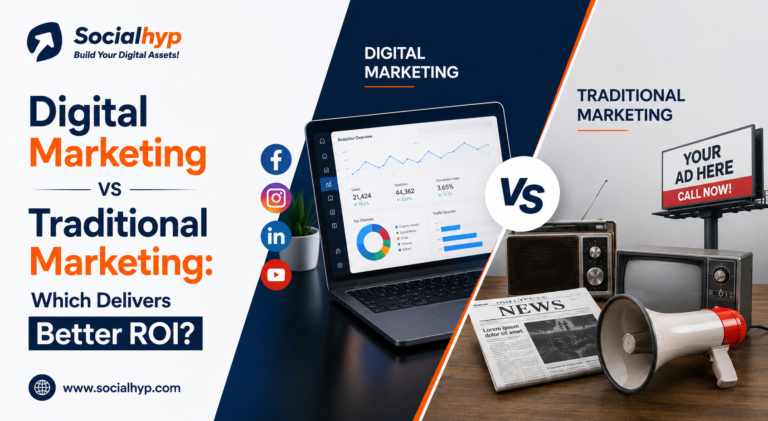
Digital Marketing vs Traditional Marketing: Which Delivers Better ROI?
Every business has one main goal when spending money on ads. You want to see a clear return on investment. If you put one dollar into your business marketing strategies, you want to get more money back. But where should you spend that dollar today?
It's a difficult decision choosing between modern and old-style ways of promoting your business. Are you going to spend money on online marketing or just continue with posters and TV?
At Social Hyp, we help companies make these choices every day. Deciding between digital marketing vs traditional marketing is not just about what looks cool. It is about where your buyers are, how much it costs to reach them, and how much profit you make.
Let us break down both methods. We will look at how they affect your marketing ROI so you can pick the right path.
Understanding the Two Contenders
Before we look at the numbers, let us define both options clearly.
What is Traditional Marketing?
Traditional marketing means any ad that does not use the internet. These are the classic paths that companies have used for decades. They print physical items or use broadcasts to reach a huge group of people at once. Examples include:
- Television and radio ads
- Ads in newspapers and magazines
- Large roadside billboards
- Mail sent to your home address
What is Digital Marketing?
Digital marketing includes all ad efforts that happen on the internet. It uses phones and computers to connect with people online. Examples include:
- Social media posts
- Search engine ads
- Email newsletters
- Short online videos
Both methods try to do the same thing. They want to show your product to buyers. But the way they do it is very different.
The Core Differences: At a Glance
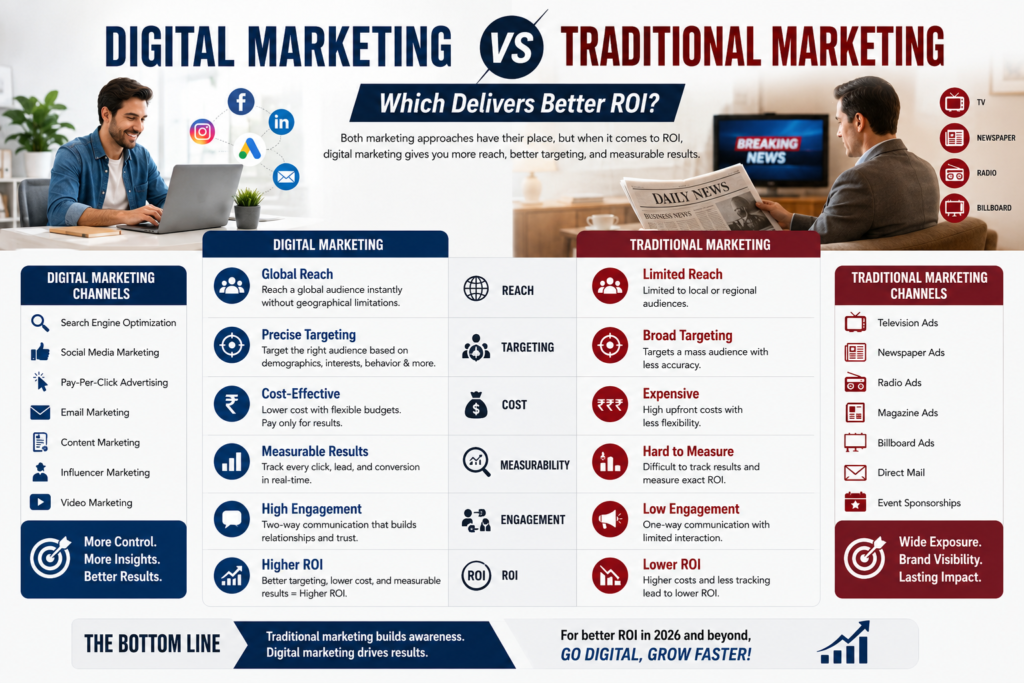
To compare digital marketing vs traditional marketing, we must look at how they work in real life. This chart shows how they match up.
Feature | Traditional Marketing | Digital Marketing |
Audience Reach | Local or mass audiences | Highly targeted |
Communication | One-way only | Two-way chat |
Cost | High upfront costs | Small daily budgets |
Tracking | Hard to measure | Simple to track |
The Deep Dive into Marketing ROI
Return on investment comes down to simple math. You subtract the costs that you had from your sales. To see which side wins the cash race, we must look at three main areas.
1. The Cost of Entry
When the shop is small, cost matters. Traditional marketing usually requires a big cash investment up front. Printing a lot of flyers or buying a radio slot can be expensive. You must pay before you ever see a single buyer. If the ad fails, you lose that money.
Online ads are different. You can start a campaign with just five dollars a day. If you see the ad is not working, you can stop it right away. You can fix the text and start over. This keeps your budget safe. It protects your marketing ROI from big losses.
2. Targeting and Precision
Imagine you own a store that sells special shoes for marathon runners.
If you put a billboard on a busy highway, thousands of people see it. But most of them do not run marathons. They are just drivers who do not care about special shoes. You are paying to show your ad to people who will never buy from you.
With internet marketing, you can choose your exact buyer. You can set your ads to show only to people who love running and live near your store. Every cent goes toward a real lead. This precision is one of the best digital marketing benefits.
3. Trackability and Data
Old media makes it hard to track your success. With a newspaper ad, you can guess how many people saw it. But you cannot prove how many bought a product because of it.
Online marketing changes the game. Tracking tools show you the exact steps a customer takes. You see how many people clicked your ad and what they bought.
You can see everything clearly. You can spend more on ads that work and drop the ads that fail. This builds a better return.
Why Digital Marketing Delivers Better ROI
Data shows that the online space gives you a better return for your money. Let us see why online ads work so well for modern business marketing strategies.
High Engagement and Trust
Old ads interrupt you. They stop your TV show or block the page you want to read. Online ads can be helpful. A good post that answers a question builds trust. Social media also lets buyers talk to you, ask questions, and leave reviews. People who chat with your brand are much more likely to buy from you.
The Power of Scale
Once you make a web page, it stays online. It works for you day and night. A good article can bring new buyers to your shop for years without any extra cost. Old ads cannot match this value. Your costs go down over time, which makes your total profit grow.
When Traditional Marketing Still Makes Sense
Online ads have huge perks, but old methods can still help in some cases.
- Mass Brand Awareness: Giant global companies use TV ads to reach millions of people at once during big games.
- Older Buyers: If your customers do not use smartphones, paper mail works well.
- Local Shops: A sign outside a diner can bring in drivers who are passing by.
For most growing brands, relying only on old ways will drain your budget too fast.
The Ultimate Verdict: Balancing the Two
Digital Marketing vs traditional marketing comparison shows that digital marketing is the most ROI-efficient for the vast majority of businesses. It offers lower costs, better tracking, and exact targeting.
The smartest companies do not drop the old ways completely. They use a mixed plan. They use the wide reach of old media to get noticed, and then they use digital advertising to finish the sale.
If you want to protect your budget, start with online tools. The power to test, learn, and grow fast ensures your cash is always working hard for you.
 Visit Socialhyp.com and start your digital transformation today!
Frequently Asked Questions (FAQs)
Small shops have tight budgets. The choice between digital marketing vs traditional marketing determines how you spend that cash. Online choices let small brands target niche groups with very little money. Old paths often require too much upfront cash.
Yes. Many top brands today only use online marketing. Suppose your customers are using mobile phones and PCs a lot of their time. Then, you can easily create a big online business without ever going for any print advertisement.
The best perks are local search maps and targeted social ads. You can show your ad only to people in your exact neighborhood. This ensures you do not waste money on people who live too far away to visit.
Paid digital advertising can bring sales within hours. You can see clicks as soon as your campaign goes live. But organic paths like search optimization take three to six months to show a real return.
Strategies where you pay per click carry the lowest risk. Your budget is safe and only when your ad is clicked will you pay the fee for the click. With the help of analytics tools, you can discover the weakest points of your advertisements and eliminate them quickly. So you don't risk spending more money on unsuccessful advertising campaigns.